
The Guaranteed Price Program for Basic Food Products was created with the objective of increasing the income of small and medium-sized agricultural producers of staple grains. The operating rules establish limits on the area cultivated and the maximum purchase volume per producer. In the case of beans, in 2025, a maximum area of 30 hectares per beneficiary was covered, and each producer was to receive 15 tons at a rate of 27 pesos per kilo.
Conceptually, the program enables the continuation of rural life and guarantees the recovery of production costs. However, the protests staged by Zacatecas farmers since December 2025 highlight the structural and operational limitations of the government initiative. The indignation of those who work the land is a symptom of the severe crisis affecting more than sixty thousand families. It is evident that, despite government support, Zacatecas agriculture is facing an unprecedented situation. In the bean-producing region, hunger and misery are rampant.
There should be no doubt that farmers are sentient beings; they make informed decisions, acting according to their needs and their own judgment. Those who claim their demands are the result of manipulation are disrespectful and reveal their profound ignorance. The greatest agitators for the farmers are the poverty caused by the monopolistic market and the incompetence of those responsible for agricultural policy. The supposed agents of evil that the mendacious press and the powers that pay it relentlessly point to have nothing to do with it.
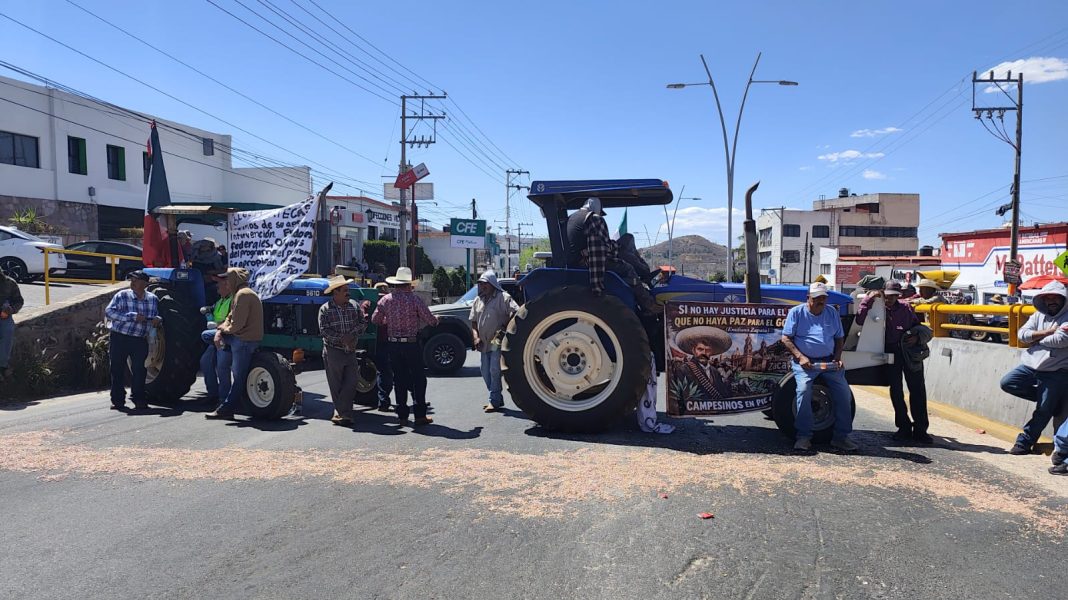
This text recovers the voices of producers who participated in road blockades and the occupation of government offices. These are the same people who stood in the Plaza de Armas of the state capital to protest the mismanagement of the bean collection centers operating in our state. Here we bring to life stories that no one usually wants to hear; we recover them to understand the hardships, fears, and causes of anger of the men and women who have dared to raise their voices against what they consider unjust.
With the certainty that the dilemmas of social life are better understood from the perspective of the perennial losers than from the accounts of those in power, we pay attention to voices like César’s:
“To be a beneficiary, you first had to register, then they gave you a number, and then you had to wait for the sacks to arrive. Once approved and with your number, you waited to be called to receive the sacks to pack the sifted beans—no stones, no sticks, no broken beans, beans in the best possible condition. But those in charge of the program, through bribes and kickbacks, would get other people on the list, bypassing the one they had.”
César’s narrative is surreal. Those of us born and raised in rural areas never imagined a situation like this. We used to harvest beans by the kilo to buy candy and toys, we easily sold sacks to meet our daily needs, we always took care to make the land productive, and we never had to beg the store owner to buy our harvest. On the contrary, selling seeds was a business, never a nightmare. Now, the bureaucratic procedures that producers have to go through to deliver their grain are agonizing, and it’s Kafkaesque that, despite meeting all the requirements, most of them can’t deliver their harvest to the collection centers.
“There’s a collection center in Enrique Estrada, but they kicked us out very quickly, so I went to the collection center in Pozo Hondo, Villa de Cos, and they just took my name; I was number 501 on the list, and they never called me. Then, on December 15th, I went and signed up again, and they received my paperwork in Calera de Víctor Rosales. They took my sample there. They told me I had been accepted and that they would call me when there were bags available. I waited fifteen days, and they didn’t call me, so I spoke with Daniel. He told me there weren’t any bags, and that I would be seen when it was my turn. I went back again fifteen days later, and by then the Christmas holidays were passing, and they still hadn’t seen me.”
The guaranteed price program has established 53 collection centers in the state of Zacatecas. If we consider the most basic administrative logic, the location of these centers should correspond to a potential number of beneficiaries. But according to Daniel, the Enrique Estrada collection center quickly filled up. How could it fill up without serving the producers on the registry it was supposed to serve, like Daniel? Were the collection centers opened without a prior assessment of beneficiaries? Many questions remain unanswered, and a public explanation would be welcome.
Having to travel from one collection center to another to deliver beans involves unnecessary and unacceptable expenses; this is shameful. What is most outrageous is that after this ordeal, Daniel was not even helped. How can this be explained? There is evidence of the program’s mismanagement that is unknown to most citizens, but the producers are well aware of it and denounce it:
“Here in this program, I detect a ton of shady dealings. Here, I’ll list them for you. Look, first and foremost, officials associated with middlemen, officials bribed by middlemen, officials fulfilling political commitments; these officials I’m talking about are the ones in charge of the program, they’re the ones in charge of distributing the aid, they’re the analysts and the center managers.”
Rodrigo is emphatic, making it clear that the obstacles to grain reception at the collection centers are not accidental, much less based on technical criteria. They are deliberate acts to discriminate against thousands of producers and favor a small segment who were given slips of paper that the farmers call “VIP Cards.” The Federal Government created a program that, according to the farmers themselves, “is good,” but nefarious interests have prevented it from reaching the majority of small producers. Zacatecans.
The anger of the farmers manifests itself in many ways. The cheerful figures of increased investment and expanded coverage are as offensive as the claim that “the producer is being directly served” when thousands of them are experiencing a situation unprecedented in recent history. The ferocity of the grain market is devastating; the farmers find no explanations or solutions, so they formulate demands and questions like Juan’s:
“Never before, or at least in all my life, have I been in a situation like this trying to sell my product. I didn’t steal it; I worked for it, I labored for it, I planted it, I cultivated it, I shelled it, I have it processed and sifted, and I can’t sell it. This is like a kidnapping of our work. What kind of world do we live in?”
The robberies committed against producers in Zacatecas have deepened the crisis triggered two years ago by extreme weather events. Despite their hard work, bean farmers are going from bad to worse. This year, they were able to sell their harvest for thirteen pesos at the farm gate, but the cost of cleaning it at the collection center resulted in losses of over 20%. The effort to join the program also meant losses, and now they can’t even sell their product for seven pesos. They feel betrayed, believing they have been used as a public facade for private businesses:
“They just used us as a mask, they used us as a shield to say the program was going to be established to collect our beans, and that’s not the case. Here we are, three hundred people, being made a mockery.”
The feeling of being cheated is widespread. The producers feel they have been the victims of multiple deceptions. For them, the bureaucratization of the collection process was nothing more than a technical and regulatory fiction to prevent them from selling their beans. Access to the federal program is limited for most small producers. The selection criteria for beneficiaries—according to the farmers—were more focused on serving political clients and fulfilling electoral commitments than on strengthening an economic activity upon which three hundred thousand Zacatecans depend.
Discouragement and sadness prevail among the producers. Leaning against the structure of one of the bleachers built for the 40th Zacatecas Cultural Festival, a burly old man with enormous hands and a shifty gaze expresses a painful truth:
“We have debts, a house to maintain, a family; well…of course, we have to support our children, our wives, pay for education, medical expenses, house maintenance, vehicle maintenance, machinery maintenance, implement maintenance. We have very high expenses; people won’t have enough to plant their land, they won’t have enough to pay their debts. There are people who went into debt for a tractor, for implements, and they won’t be able to pay them off. There’s going to be a recession because of the mismanagement of this program.”
Source: ljz